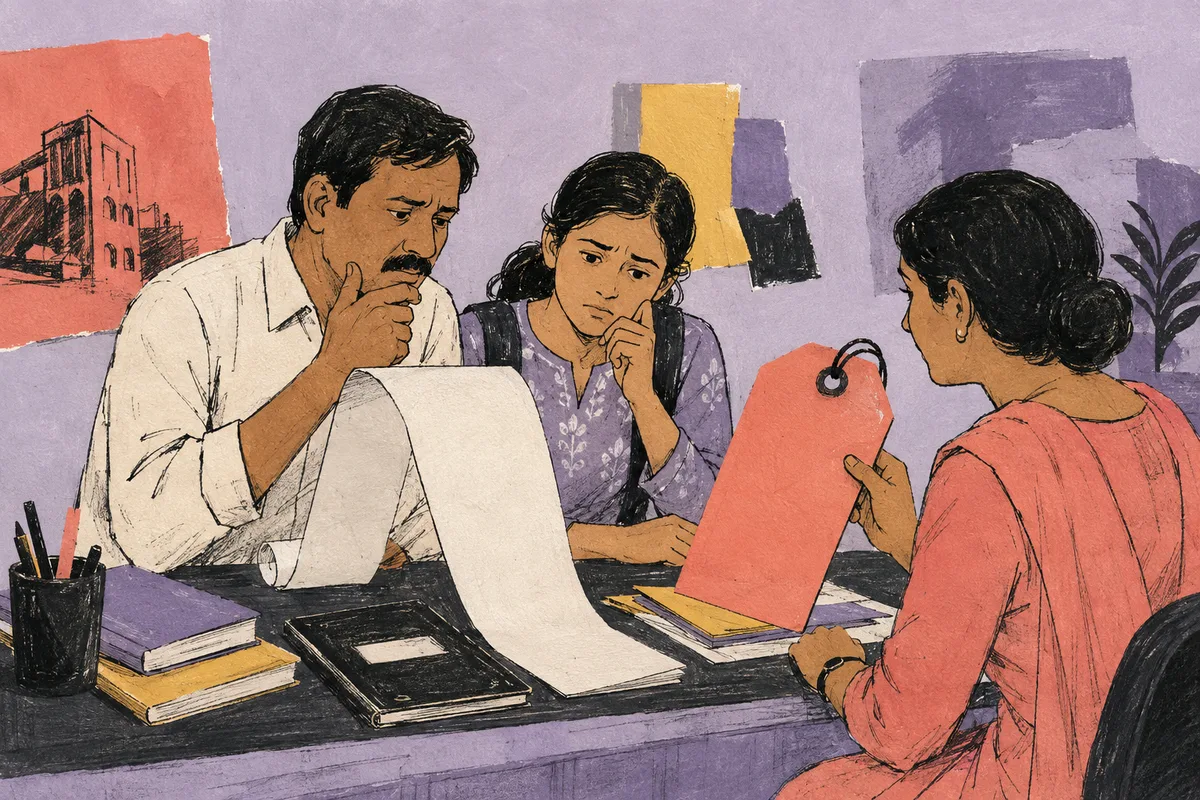
“You have a 50% scholarship” sounds like half the bill is gone. In one aspirant’s account, it applied only to tuition and still left about ₹1.5 lakh payable on a stated ₹2.35 lakh programme.
We have not seen the written offer, so that claim is not proven. It does show the family’s real question: “What will we have to pay in total before we say yes?”
The discount and the final bill are different things
A headline discount may cover one component while registration, materials, accommodation or other charges remain. Refund and exit terms can create a second source of uncertainty.
A large fee is not automatically a loss or a misleading offer. The problem exists only when the written total or conditions are genuinely hard to understand before payment.
The usual moment this begins is before enrolment when discounts, fee components or exit terms are unclear. What follows is a household may misunderstand the payable total or refund terms.
What “50% scholarship” may leave out
A family may hear “half off” on a call, then later find registration, materials, accommodation or another charge outside the discount. The price may be valid; the problem is not being able to understand the full commitment before paying.
A high fee alone is not evidence of a bad offer. The written terms decide what is included.
What is supported by evidence—and what is still only a hypothesis?
What the evidence says
Episode 19 reports a 50% tuition discount and about ₹1.5 lakh payable on a stated ₹2.35 lakh programme.
The fee sheet is unavailable, so the claim cannot be reconciled.
Institutional guidance substantiates broader concern, not this specific case.
What we know
- ~₹1.5L payable, according to the aspirant
- 50% tuition discount Reported in source · fee sheet unavailable
- Evidence level
- E2 Substantiated
- Field interviews
- Not completed Proposed in the next test
Counterargument: The tuition-only discount may be correctly disclosed. Clear written terms or free help may be sufficient.
Who pays for clarity before enrolment?
The family bears the large enrolment decision, but that does not prove it will pay for a separate comparison. A low-priced review becomes difficult if every offer needs hours of interpretation.
About ₹1.5 lakh was quoted after the reported discount. Completed payment is unknown.
Who might pay: Student, parent or institution could pay. A payer for comparison is not established.
| Price to test | ₹499 |
|---|---|
| Direct cash cost | − ₹50 |
| Contribution before owner time | ₹449 |
| Owner time | 3 hours × ₹150 |
| Contribution after owner time | ₹-1 |
These numbers are not a forecast. They make the hypothesis measurable and keep weak economics visible.
How families check an offer now
Prospects can ask the institute counsellor, involve family members and read the written offer. A free checklist may resolve the issue without a paid service.
Why the headline wins attention
The decision is emotional and time-sensitive. Parents and students may focus on the scholarship headline, while the detailed terms are in a separate document or explained quickly on a call.
Headline discounts may obscure separate fee components. Sellers may emphasize attractive headline terms; this does not establish fraud.
What could make a test easier: CCPA guidance explicitly addresses misleading fee and refund claims.
A checklist may be more useful than a service
A narrow comparison could restate the payable total, included components and exit terms from the written offer.
The useful test is whether confusion remains after a plain checklist—not whether families dislike the price.
Free fee checklist
Help families request every fee and refund term in writing.
Weakness: If this works, no paid service is needed.
Bounded comparison
Compare up to three written offers without admissions promises.
Weakness: At ₹499, three hours produces slightly negative contribution after owner time.
Practical boundary: Information-only scope. Qualified advice is needed for disputes. Yes for factual comparison only.
How we’d test this for ₹1,500
Start with evidence, not a product. The experiment should answer one decision before any larger commitment.
- Participants
- 10 recent prospects or parents
- Time
- 7 days
- Research budget
- ~₹1,500
- Owner time
- 12 hours
After using a free checklist, do recent prospects still have a material fee or refund term they cannot resolve?
- Collect redacted written offers.
- Compare initial interpretation with terms and a free checklist.
- Record remaining confusion and discuss who would pay.
Continue if
- 4 of 10 still have a material unresolved term.
- 2 request a scoped paid comparison discussion.
Stop if
- Offers are already clear.
- The checklist resolves the issue.
- No plausible payer or price covers labour.
Will you test this?
These are our proposed decision rules, not industry benchmarks.
Why careful comparison can still be a poor business
This is a one-off decision with free alternatives. The service may attract legal expectations, while a price low enough for families may not cover careful review.
- Low willingness to pay, one-off use, free resources and legal-advice expectations.
If nobody will pay for this, it is not a business—just a real problem.
Evidence snapshot
Opportunity snapshot
A public view of what is known before a solution is proposed. It is not a market-size or margin claim.
- Pain / severity
- Consequence reported; prevalence is not established.
- Who pays
- Student, parent or institution could pay. A payer for comparison is not established.
- Current alternatives
- Ask the institute counsellor or family and read the written offer. Independent comparison spending is unknown.
- Test cost
- Proposed 7-day research budget: ₹1,500.
- Main risk
- Low willingness to pay, one-off use, free resources and legal-advice expectations.
- Evidence
- E2 · Substantiated.
What would change our mind? The tuition-only discount may be correctly disclosed. Clear written terms or free help may be sufficient. We would also need: Who pays when a free checklist may work?
Our current view
The broad clarity problem is credible. A small paid service is not yet proven.
Real written offers will show whether the gap is in the documents, the sales conversation or simply the household’s reaction to a high total.
Next move: Interview families using real written offers.
Research notes
- Problem score
- 49 / 100
- Opportunity score
- 31–66 / 100
- Biggest unknown
- Who pays when a free checklist may work?
Scores are internal research judgments, not probabilities of success.
Sources
Sources support the specific claims described here. A reported account or an operator’s existence does not validate a market-wide opportunity.
Business Mastery · Episode 19
Source conversation
Participant or facilitator account. Figures have not been independently verified.
Open source ↗CCPA coaching advertising guidance
Institutional evidence
Covers misleading fee and refund claims; does not verify the episode case.
Open source ↗Consumer protection action on coaching centres
Institutional evidence
Shows enforcement attention, not the facts of this claim.
Open source ↗
Reality check
Does this happen in real life?
One anonymous signal helps us decide what to investigate next.
Continue exploring