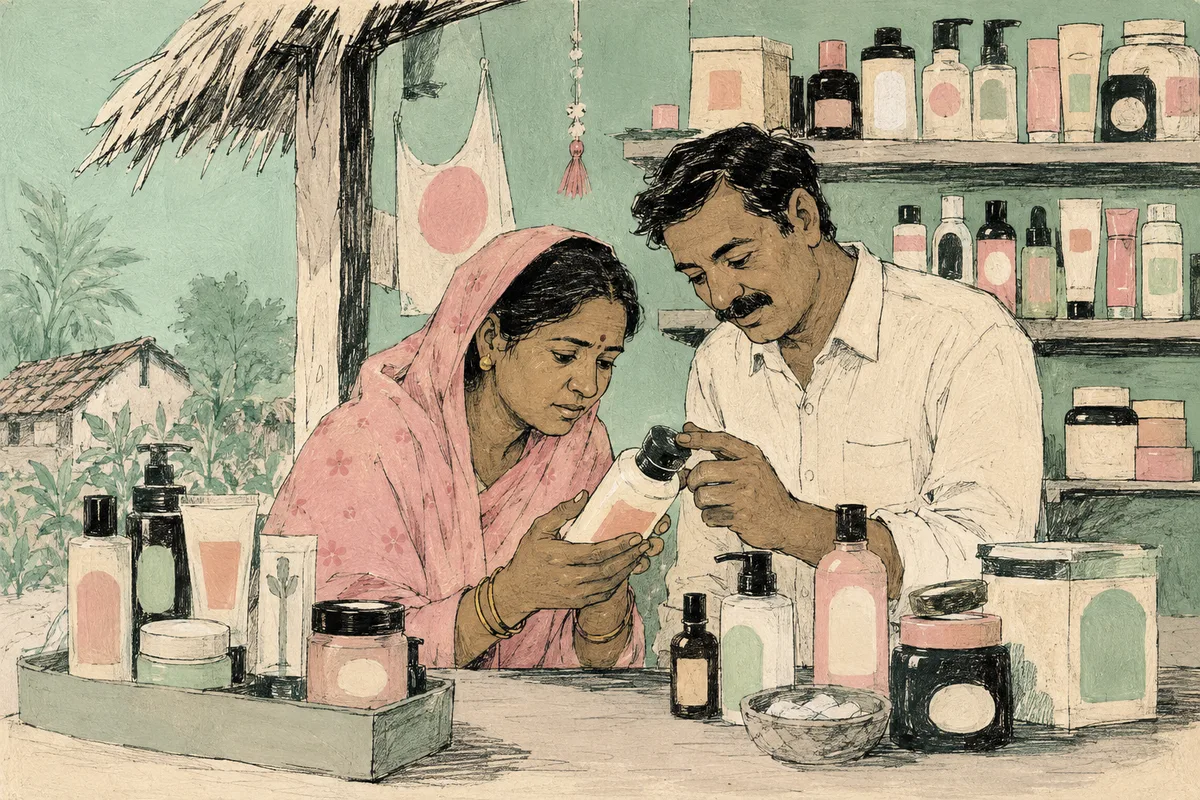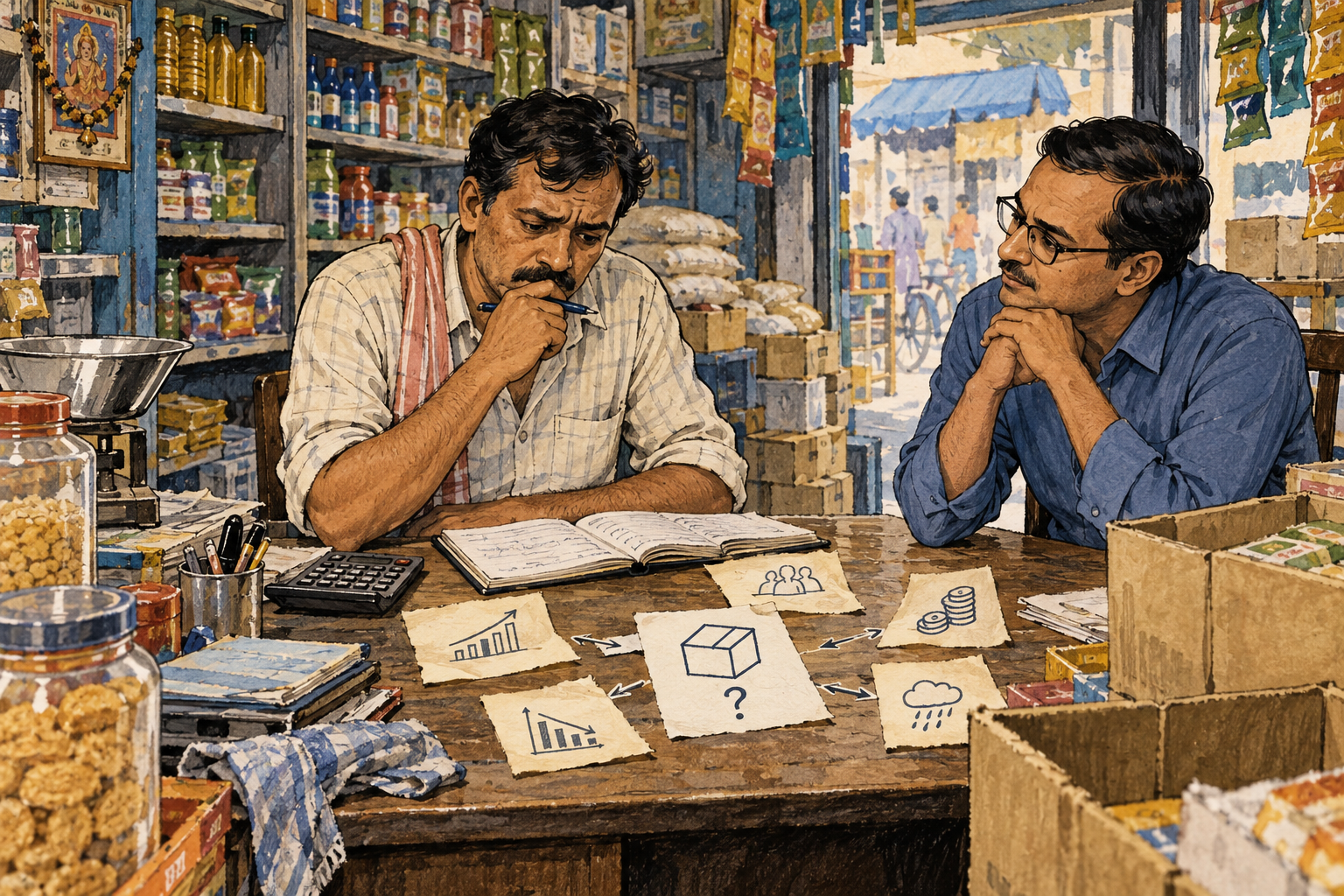
A patient or caregiver can hold a medicine box and a bill and still wonder: “Does this prove the medicine is safe?”
A bill, source record or batch number can answer part of the story. None of them can prove the chemical quality inside the box. Any checklist that pretends otherwise would be dangerous.
A printed label cannot answer every trust question
The narrow question is whether buyers can understand the source, invoice and batch evidence already available when something looks unclear.
One complaint and one older discussion do not establish how often the problem occurs, whether harm resulted or whether existing pharmacist support failed.
The usual moment this begins is when invoice, pack or sourcing information is unclear. What follows is uncertainty and extra verification effort; chemical quality and injury are not established.
What a bill and batch number can actually show
A simple check might help someone compare the name, batch and expiry on the box with the bill and ask the seller a better question. It cannot test what is inside the medicine.
If medicine looks wrong or someone feels unwell, a consumer guide is not the answer. The safe route is a qualified healthcare professional and the appropriate regulator or pharmacy process.
What is supported by evidence—and what is still only a hypothesis?
What the evidence says
One accessible customer complaint supports an anecdotal signal.
Institutional and operator procedures show bounded verification methods exist.
No measured incidence, time loss or spurious-drug rate supports this narrow problem.
What we know
- incidence and harm are unknown
- One complaint + one lead Professional review required
- Evidence level
- E0 Anecdotal
- Field interviews
- Not completed Proposed in the next test
Counterargument: A discrepancy may be clerical, and pharmacist support may resolve it for free.
Who would pay for more confidence?
People already pay for medicine, but separate spending on verification is unproven. A low-fee review also carries high responsibility, professional involvement and secure record handling.
Medicine purchases exist; separate verification spending is insufficiently evidenced.
Who might pay: Pharmacy, patient or another party might pay. We do not have enough evidence yet to estimate this reliably.
| Price to test | ₹1,000 |
|---|---|
| Direct cash cost | − ₹400 |
| Contribution before owner time | ₹600 |
| Owner time | 3 hours × ₹150 |
| Contribution after owner time | ₹150 |
These numbers are not a forecast. They make the hypothesis measurable and keep weak economics visible.
How medicine buyers check trust now
Buyers can ask the pharmacist or store support and inspect the bill and pack. Existing pharmacy processes may already resolve most discrepancies for free.
Why certainty is impossible at the counter
Medicine decisions are stressful. Labels use technical language, people may be rushed, and a buyer can confuse a useful record check with a safety guarantee it cannot provide.
Invoice and pack records may be hard to reconcile. Consumers cannot perform laboratory quality tests; a checklist cannot certify medicine.
What could make a test easier: Sourcing records can support bounded explanations.
A narrow explanation is safer than a promise
A pharmacist-reviewed workflow might explain exactly what the available records support and when to escalate.
The gap is bounded information, not a consumer test for medicine quality. False reassurance would make the approach harmful.
Pharmacist-reviewed checklist
Explain only what source, invoice and batch records can verify.
Weakness: It can create false reassurance.
Pharmacy documentation workflow
Improve bills and source-record explanations.
Weakness: The pharmacy may see no reason to pay.
Practical boundary: A registered pharmacist must review the workflow. No diagnosis or drug sale. A registered pharmacist can test it; a beginner needs a partner.
How we’d test this for ₹3,000
Start with evidence, not a product. The experiment should answer one decision before any larger commitment.
- Participants
- 10 patients · 5 pharmacists · 2 doctors
- Time
- 7 days
- Research budget
- ~₹3,000
- Owner time
- 16 hours
Can a pharmacist-approved workflow resolve a real information gap without making any participant think chemical quality has been certified?
- Get qualified scope and consent review.
- Interview patients and professionals.
- Test one bounded pack/invoice task with the same patients.
Continue if
- 6 of 10 complete the task correctly.
- No participant believes it proves chemical quality.
- 2 of 5 pharmacists identify a useful gap.
Stop if
- False reassurance persists.
- No professional-recognized gap appears.
- Meaningful records are unavailable.
Will you test this?
These are our proposed decision rules, not industry benchmarks.
False reassurance could do real harm
Sensitive records, unclear payment and false reassurance make this a high-trust area. A beginner cannot safely test it without a registered pharmacist.
- High trust, sensitive records, weak payer and false-reassurance risk.
If nobody will pay for this, it is not a business—just a real problem.
Evidence snapshot
Opportunity snapshot
A public view of what is known before a solution is proposed. It is not a market-size or margin claim.
- Pain / severity
- Consequence reported; prevalence is not established.
- Who pays
- Pharmacy, patient or another party might pay. We do not have enough evidence yet to estimate this reliably.
- Current alternatives
- Ask the pharmacist or store support and inspect invoices or pack information. Existing processes may already resolve many cases.
- Test cost
- Proposed 7-day research budget: ₹3,000.
- Main risk
- High trust, sensitive records, weak payer and false-reassurance risk.
- Evidence
- E0 · Anecdotal.
What would change our mind? A discrepancy may be clerical, and pharmacist support may resolve it for free. We would also need: Can a safe workflow resolve a real information gap?
Our current view
Potentially important, but weakly evidenced and high-trust.
Qualified scope comes first. If professionals do not recognize a bounded information gap, the investigation should stop.
Next move: Find a qualified pharmacist first.
Research notes
- Problem score
- 17–32 / 100
- Opportunity score
- 25–60 / 100
- Biggest unknown
- Can a safe workflow resolve a real information gap?
Scores are internal research judgments, not probabilities of success.
Sources
Sources support the specific claims described here. A reported account or an operator’s existence does not validate a market-wide opportunity.
Business Mastery · Episode 3
Source conversation
Participant or facilitator account. Figures have not been independently verified.
Open source ↗Jan Aushadhi FAQs
Institutional source
Describes quality controls; does not establish consumer difficulty.
Open source ↗Apollo Pharmacy authenticity process
Existing operator
Operator trust mechanism, not an independent audit.
Open source ↗Tata 1mg genuine medicines
Existing operator
Operator policy, not proof of a separate paid gap.
Open source ↗
Reality check
Does this happen in real life?
One anonymous signal helps us decide what to investigate next.
Continue exploring