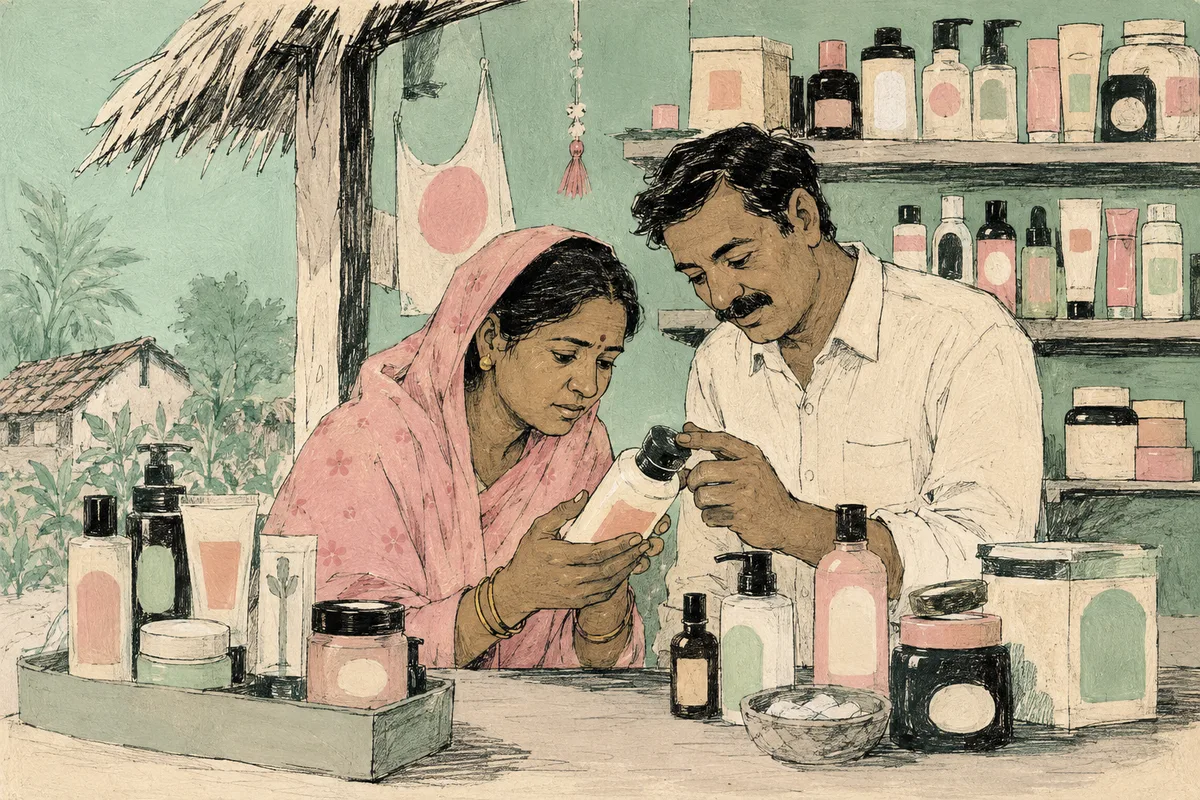
A buyer finds a cosmetic item on a village shop shelf. The question is not only, “Can I buy it?” It is also, “Is it in date, where did it come from, and is this price fair for this size?”
The original account described unbranded, costly and sometimes expired stock. We do not have receipts, matched products or an inspection, so those are reports to check—not facts about every local shop.
The product is there. Trust is the missing part.
A local purchase can involve more than availability. Buyers may need to compare expiry, source, size and price, while small shops manage low volumes and the risk of unsold stock.
Price differences alone do not prove overcharging. The same-looking items may differ in size or quality, and transport can be part of the local cost.
The usual moment this begins is when replenishing a cosmetic item locally. What follows is extra search or travel, or buying unsuitable stock. Health damage is not established.
Compare the same item, not two lookalikes
Two jars can look alike but differ in size, source or quality. A higher local price may include transport. “It costs more” is not enough evidence.
The useful first check is boring: photograph recent items, note expiry and size, save the receipt, then compare the same item with a credible supplier.
What is supported by evidence—and what is still only a hypothesis?
What the evidence says
One observer reported unbranded, expensive and sometimes expired cosmetics.
The ₹30 versus ₹250–300 comparison did not match SKU, size, source or expiry.
Nykaa and Purplle show sourcing models, not repeated village complaints.
What we know
- buyer experiences still needed
- One village observer Anecdotal · no local interviews
- Evidence level
- E0 Anecdotal
- Field interviews
- Not completed Proposed in the next test
Counterargument: Current shops may offer acceptable products, credit and advice. Online sellers may already serve the area.
What verified access would have to cover
A retailer or delivery model must cover verified stock, travel, expiry risk and owner time. The test model assumes a small basket; it does not establish that buyers will pay more for verification.
₹250–300 per reported item is unverified. There is no defensible loss estimate.
Who might pay: The buyer pays for products. Willingness to pay more for verified stock is unknown.
| Price to test | ₹500 |
|---|---|
| Direct cash cost | − ₹400 |
| Contribution before owner time | ₹100 |
| Owner time | 0.5 hours × ₹150 |
| Contribution after owner time | ₹25 |
These numbers are not a forecast. They make the hypothesis measurable and keep weak economics visible.
Where local buyers shop now
People may buy from current shops, travel to a larger market or order online. The research has not observed which option local buyers actually choose or where it fails.
Why a new shelf can create a new problem
Small shops cannot carry every brand, and local buyers may not want to travel or wait for delivery. Stock that moves slowly also creates an expiry risk for anyone trying to “solve” the problem with more inventory.
Source and expiry may be hard to compare. Small volumes and travel may sustain price differences; deception is not established.
What could make a test easier: Verified catalogues and remote ordering can widen access.
Verification may matter more than more stock
A gap may exist in verification and access rather than in opening another stocked shop.
Recent purchases and supplier quotes can show whether a small catalogue or order service improves choice without taking inventory risk.
Stock and receipt audit
Check what is sold, for how much and with what expiry/source evidence.
Weakness: Shops may refuse inspection.
Paid limited-SKU preorder
Buy only after completed payment and an authorized quote.
Weakness: Thin delivery margin and unsold shades can erase value.
Practical boundary: Verify retail and product rules plus supplier authorization. Yes, with a compliant supply channel.
How we’d test this for ₹2,500
Start with evidence, not a product. The experiment should answer one decision before any larger commitment.
- Participants
- 15 recent buyers · 3 local shops
- Time
- 7 days
- Research budget
- ~₹2,500
- Owner time
- 14 hours
Do recent buyers show a repeated, documentable problem that a credible supplier can solve at a workable delivered price?
- Recruit and inspect with permission.
- Match items or receipts.
- Compare supplier quotes and alternatives. No stock purchase.
Continue if
- 5 of 15 describe a recent specific event.
- 3 provide a receipt or item.
- One credible supplier quote is obtained.
Stop if
- Few specific cases appear.
- No artifacts are inspectable.
- Existing supply is adequate at equal or better cost.
Will you test this?
These are our proposed decision rules, not industry benchmarks.
Why slow stock and thin delivery can hurt
Existing shops may already be adequate. Buyers may resist a higher price, while slow-moving cosmetics can expire before a new seller recovers the cost.
- Existing relationships, low willingness to pay more and expiry risk.
If nobody will pay for this, it is not a business—just a real problem.
Evidence snapshot
Opportunity snapshot
A public view of what is known before a solution is proposed. It is not a market-size or margin claim.
- Pain / severity
- Consequence reported; prevalence is not established.
- Who pays
- The buyer pays for products. Willingness to pay more for verified stock is unknown.
- Current alternatives
- Buying from current shops is reported. Travel or online ordering are alternatives to investigate, not observed local behaviour.
- Test cost
- Proposed 7-day research budget: ₹2,500.
- Main risk
- Existing relationships, low willingness to pay more and expiry risk.
- Evidence
- E0 · Anecdotal.
What would change our mind? Current shops may offer acceptable products, credit and advice. Online sellers may already serve the area. We would also need: Will buyers pay enough to cover delivery and owner time?
Our current view
Anecdotal but testable. Do not buy stock yet.
Inspect recent items and receipts, then compare one credible supplier quote. The investigation should stop if the local supply is already adequate at equal or better cost.
Next move: Audit recent purchases and stock.
Research notes
- Problem score
- 25–40 / 100
- Opportunity score
- 43–63 / 100
- Biggest unknown
- Will buyers pay enough to cover delivery and owner time?
Scores are internal research judgments, not probabilities of success.
Sources
Sources support the specific claims described here. A reported account or an operator’s existence does not validate a market-wide opportunity.
Business Mastery · Episode 1
Source conversation
Participant or facilitator account. Figures have not been independently verified.
Open source ↗Nykaa authenticity policy
Operator example
Shows a sourcing approach, not independent proof of village demand.
Open source ↗Purplle authenticity policy
Operator example
Shows another sourcing policy. Local availability and economics are unknown.
Open source ↗
Reality check
Does this happen in real life?
One anonymous signal helps us decide what to investigate next.
Continue exploring