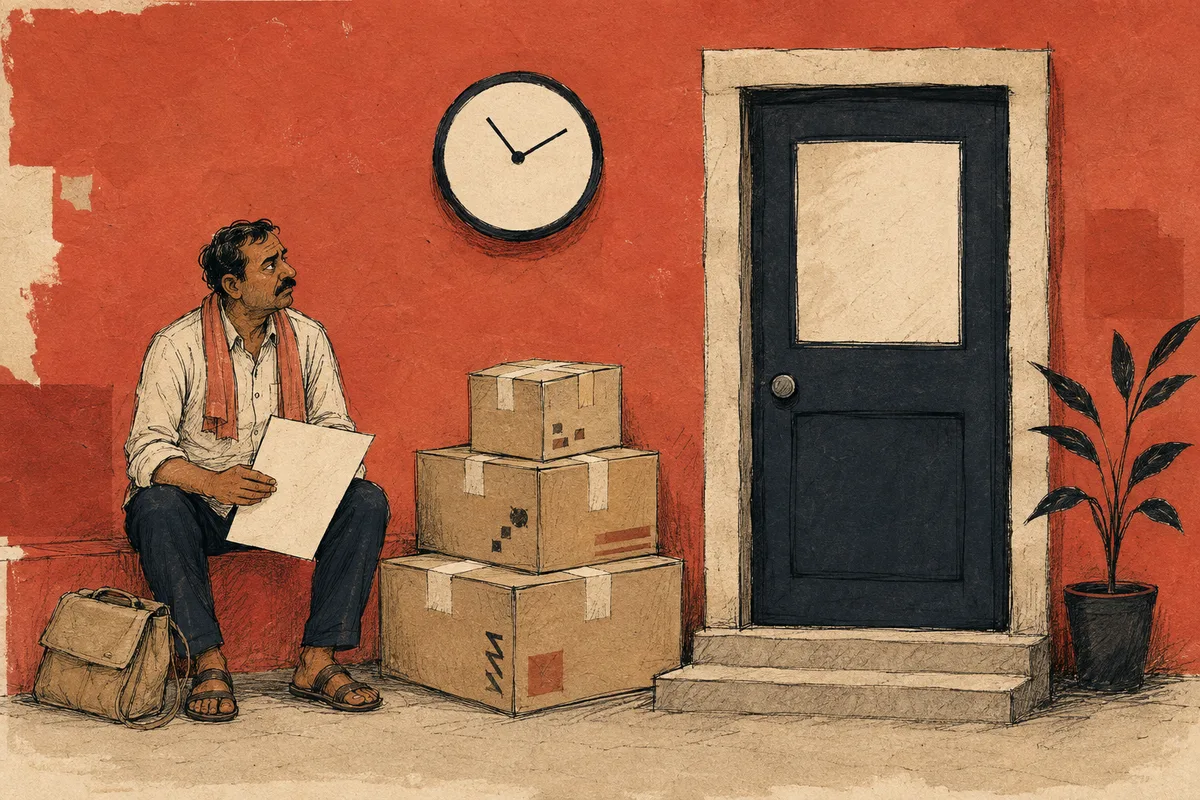
A small supplier finishes the job, sends the invoice and expects payment. Then the weeks start passing and every call becomes, “Has it been approved yet?”
The sale is written down. The cash is not in the bank. Wages, material bills and the next order do not wait politely for the buyer’s accounts team.
First the work gets done. Then the waiting starts.
Once work is delivered, payment can stall around acceptance, paperwork, a dispute or the buyer’s control over timing.
Official complaint data shows a broad problem. It does not show which delays a small service could change.
The usual moment this begins is after delivering on credit when acceptance or payment stalls. What follows is working capital is tied up and operating payments become harder.
One missing proof can hold up the whole invoice
A supplier may need signed delivery proof and a clear invoice. If both are buried in chat, chasing paperwork can take longer than fixing it.
But neat paperwork cannot create a buyer’s cash or settle a real dispute.
What is supported by evidence—and what is still only a hypothesis?
What the evidence says
Official reporting substantiates a broad delayed-payment problem among Indian micro and small enterprises.
The report lists 256,892 applications involving ₹55,244.31 crore as of 31 December 2025. Applications are not unique firms or realized losses.
Episode 13 is a source signal, not a verified overdue-invoice case.
What we know
- involved in 256,892 applications
- ₹55,244.31 crore Official report · as of 31 Dec 2025
- Evidence level
- E2 Substantiated
- Field interviews
- Not completed Proposed in the next test
Counterargument: Buyer liquidity, bargaining power or a substantive dispute may dominate. Better paperwork cannot make an unwilling buyer pay.
Where the money gets stuck
An overdue invoice belongs to the supplier. A service earns its fee only by reducing avoidable delay or follow-up work.
Receivables are money owed, not provider revenue. Finance and administrative spending are insufficiently evidenced.
Who might pay: The supplier would pay for a bounded administrative service. Willingness to pay is unknown.
| Price to test | ₹1,500 |
|---|---|
| Direct cash cost | − ₹150 |
| Contribution before owner time | ₹1,350 |
| Owner time | 6 hours × ₹150 |
| Contribution after owner time | ₹450 |
These numbers are not a forecast. They make the hypothesis measurable and keep weak economics visible.
What small suppliers do while they wait
Suppliers follow up, use formal delayed-payment processes and sometimes finance accepted receivables. We do not yet know where a fixable admin gap remains.
Why another reminder does not always fix it
The supplier often wants to preserve the buyer relationship, records are made while work is moving fast, and formal action can feel intimidating. That makes repeated follow-up the default, even when it is slow.
Buyer bargaining power and acceptance dependency may delay payment. Buyers have an incentive to preserve cash. Documentation gaps may contribute in only some cases.
What could make a test easier: Samadhaan reporting makes repeated complaints visible. Accepted-receivable finance provides an alternative for eligible invoices.
Where there may actually be a business
A bounded service might organize invoice, acceptance and dispute records before the supplier chooses a formal route.
The addressable slice may be small: clean documentation cannot force an unwilling or cash-constrained buyer to pay.
Invoice-readiness review
Check the order, invoice, acceptance and reminder trail.
Weakness: It cannot solve insolvency, buyer power or a dispute.
Reminder-cycle support
Run a documented follow-up process for eligible invoices.
Weakness: Value may not appear in a short test window.
Practical boundary: Supplier authorization. Finance, representation, collection and legal action need qualified scope. Yes for a bounded administrative review.
How we’d test this for ₹2,000
Start with evidence, not a product. The experiment should answer one decision before any larger commitment.
- Participants
- 5 suppliers · redacted invoice histories
- Time
- 7 days
- Research budget
- ~₹2,000
- Owner time
- 16 hours
What share of real delays includes a fixable administrative gap rather than a dispute, weak bargaining power or missing cash?
- Recruit suppliers and define a safe administrative scope.
- Inspect invoices, acceptance evidence and dispute status.
- Classify causes and compare existing formal routes.
Continue if
- 3 of 5 provide usable records.
- 2 have an undisputed invoice delayed partly by a fixable admin gap.
Stop if
- Every delay is illiquidity, bargaining power or dispute.
- Owners refuse safe record access.
- Work expands into unqualified collection or legal activity.
Will you test this?
These are our proposed decision rules, not industry benchmarks.
What could kill this idea
The work can drift into debt collection or legal advice, damage a buyer relationship, or produce no result because documentation was never the real cause of delay.
- Buyer cooperation, relationship risk and disputed deliveries.
- Pressure to provide unqualified legal or collection services.
If nobody will pay for this, it is not a business—just a real problem.
Evidence snapshot
Opportunity snapshot
A public view of what is known before a solution is proposed. It is not a market-size or margin claim.
- Pain / severity
- High consequence reported; prevalence is not established.
- Who pays
- The supplier would pay for a bounded administrative service. Willingness to pay is unknown.
- Current alternatives
- Internal follow-up, formal delayed-payment processes and accepted-receivable financing. Actual usage and spend need field interviews.
- Test cost
- Proposed 7-day research budget: ₹2,000.
- Main risk
- Buyer cooperation, relationship risk and disputed deliveries.
- Evidence
- E2 · Substantiated.
What would change our mind? Buyer liquidity, bargaining power or a substantive dispute may dominate. Better paperwork cannot make an unwilling buyer pay. We would also need: What share of delays can a small administrative service influence?
Our current view
The problem is substantiated. The addressable administrative slice is not.
The next useful evidence is a set of real invoice histories showing why payment stalled and which part, if any, a small service could influence.
Next move: Observe real invoice workflows first.
Research notes
- Problem score
- 63 / 100
- Opportunity score
- 40–60 / 100
- Biggest unknown
- What share of delays can a small administrative service influence?
Scores are internal research judgments, not probabilities of success.
Sources
Sources support the specific claims described here. A reported account or an operator’s existence does not validate a market-wide opportunity.
Business Mastery · Episode 13
Source conversation
Participant or facilitator account. Figures have not been independently verified.
Open source ↗Parliament of India · Report 333
Institutional evidence
March 2026 report, page 29. Broad MSE applications, not packaging-only incidence.
Open source ↗M1xchange · TReDS
Existing operator
Shows accepted-receivable financing as an existing route.
Open source ↗RXIL · FAQs
Existing operator
Explains a financing alternative; not proof that admin support changes timing.
Open source ↗
Reality check
Does this happen in real life?
One anonymous signal helps us decide what to investigate next.
Continue exploring